

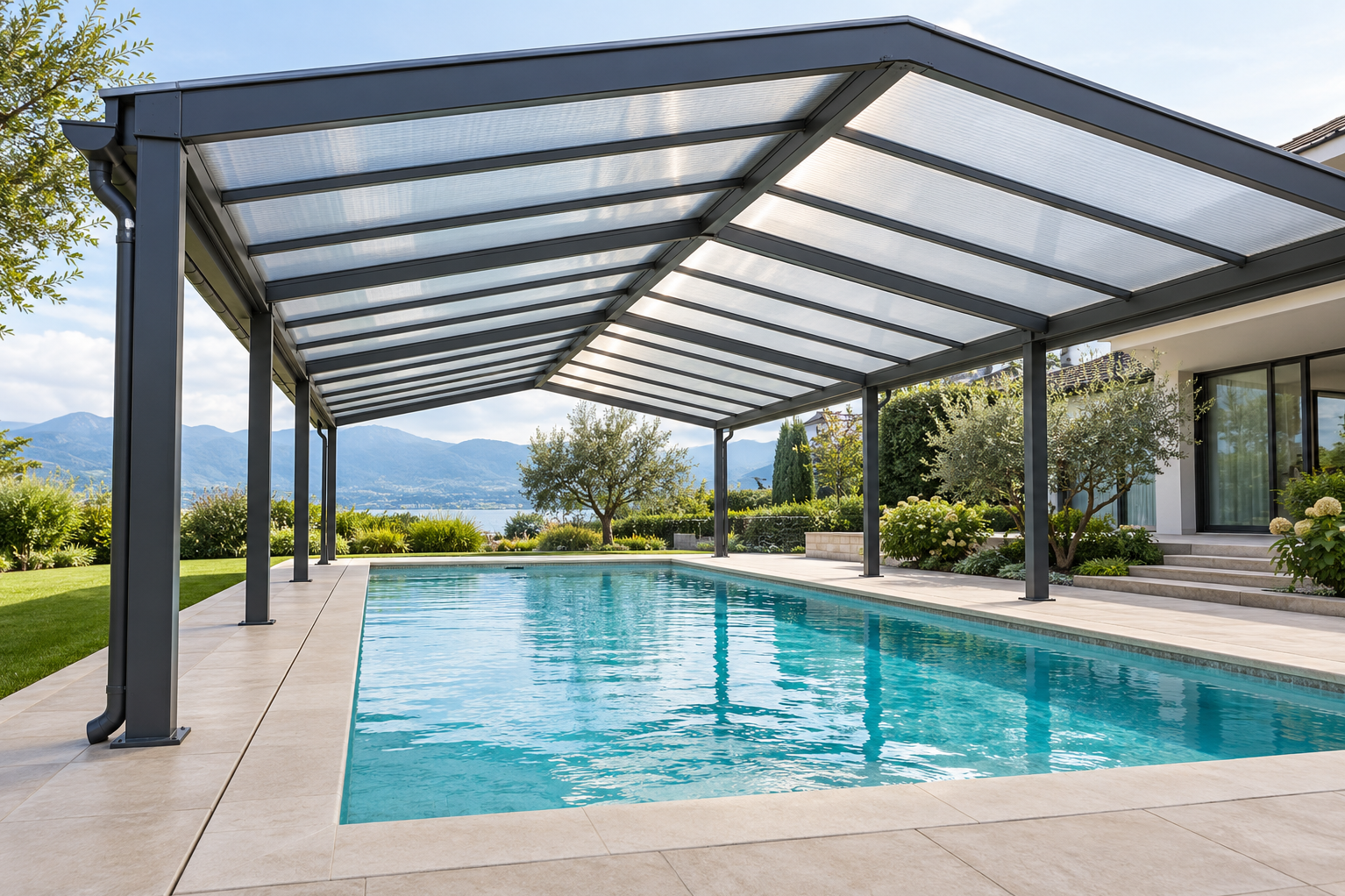
An outdoor swimming pool can be affected by falling leaves, dust, intense sunlight, rain, and surrounding environmental conditions. A well-planned roof or enclosure can reduce direct exposure while allowing the pool area to retain an open, naturally illuminated character.
For property owners considering Swimming Pool Covering with Structure in New Delhi, the decision should begin with how the pool is used rather than simply selecting a roofing sheet.
Decide What the Cover Needs to Achieve
Different pool owners have different priorities.
The covering may be intended to:
- Reduce leaves and external debris
- Provide partial weather protection
- Create shade
- Maintain daylight
- Improve usability during light rain
- Cover a surrounding deck
- Create a more defined pool enclosure
The intended purpose affects the roof height, coverage area, transparency, sheet type, and structural configuration.
Think About Heat and Daylight
Transparent roofing allows substantial daylight, but a pool enclosure also needs to remain comfortable.
Sheet colour, transparency, ventilation, roof height, surrounding openings, and shading conditions can influence the environment below the covering.
In Delhi's hot summers, simply maximizing transparency may not always provide the desired comfort. Tinted, diffused, or other appropriate polycarbonate configurations can be evaluated according to the project.
Ventilation Is Essential
A pool environment contains moisture.
An enclosure that is too tightly closed without suitable ventilation can create condensation and uncomfortable humidity. This is particularly important when the covering extends down the sides or forms a largely enclosed space.
Natural or designed ventilation should therefore be part of the concept from the beginning.
Consider the Structural Environment
Poolside structures are exposed to moisture and require suitable material and finishing choices.
The frame design should account for:
- Span
- Roof geometry
- Supporting points
- Wind exposure
- Drainage
- Corrosion protection
- Maintenance access
- Sheet fixing
The structural design should be appropriate for the actual site rather than copied from a smaller installation.
Plan Rainwater Direction Carefully
Water running from a large pool covering needs somewhere to go.
Roof slope, gutters, outlets, and discharge points should prevent rainwater from being directed onto pool decks, entrances, neighbouring spaces, or areas where it could create slippery conditions.
Request a Complete Project Specification
Before selecting a fabricator, ask for clarity on sheet type, thickness, frame specification, finishing, fasteners, sealing, drainage, and installation.
Polyfab Traders provides polycarbonate and fabricated covering solutions for customers in New Delhi, Delhi, where pool structures may need to balance weather exposure, appearance, daylight, and maintenance considerations.
A pool covering should be treated as an integrated architectural structure rather than a sheet roof added over an existing space.
When ventilation, sunlight, moisture, drainage, structure, and material selection are addressed together, the resulting covering can make the swimming pool area more practical while preserving the bright, open quality that makes the space enjoyable.